With the London Book Fair dust settled, it’s a perfect time to run some numbers and see what they tell. It’s not that I love math (well, I do), but it’s always good to do a reality check and test how the feelings and numbers correlate. Feelings often lie; numbers usually do not.
The official reports from Olympia London describe the 2026 fair as “high energy” and “confident.”
On paper, the industry has never looked healthier. But if you look beneath the headline numbers, a different story emerges—one that every publisher should be worried about.
The Numbers: A False Sense of Security?
LBF 2026 was announced to be a big success with a record-setting number of both visitors and exhibitors.
While total attendance is up, the exhibitor breakdown reveals a fragmented landscape. The growth isn’t coming from traditional manufacturing hubs; it’s driven by a 15%-18% influx of new exhibitors, largely dominated by digital service providers, AI startups, and independent platforms.
As a seasoned offset printer, I see this as a double-edged sword. While more people are talking about books, the physical craft of the book is being sidelined in favor of “print local” idealism and “good enough” digital printing standards.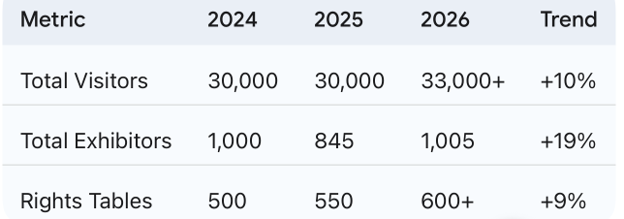
The ‘Print Local = Print Green’ Mirage
The 2026 trend toward distributed, local printing has been pitched as a sustainability win. But here is the reality check: Local digital hubs simply lack the technical capacity—neither to produce high-spec trade books, nor to produce them in adequate quantities.
A 200-page monochrome paperback is a commodity, not a keepsake. If the industry lowers its standards to “meet shipping timelines” or “reduce carbon footprint,” we lose the tactile complexity—the foil, the deep embossing, the color fidelity—that justifies a premium price point in a crowded market.
There is definitely a huge inner contradiction: Decade after decade, readers were getting used to more and more heightened standards of printing, binding, cover design, and color transmission. In today’s crowded market, by offering mediocrity to a reader, you risk losing them.
On top of that, printing a “disposable” book locally is much less “green” than you’d think:
-
Increased waste, as the book doesn’t feel like a value.
-
Is printing and binding a less “green” production than manufacturing digital printing equipment? I’m not sure.
-
Big printers are simply forced to be more eco-friendly by the authorities than mom-and-pop print shops.
-
Finally, eco-conscious offset printers like ourselves can go fully green. Thus, Matsis Global Print Solutions built a solar-powered station to cover all their energy needs. Can a local printer do the same?
The Evidence: Our Own ‘Stand Stats’
The energy at the specialist manufacturing stand tells quite a different story of what publishers actually want.
At our stand this year, we recorded a 15% increase in visitors compared to 2025.
More importantly, over 80% of those visitors were publishers specifically looking for ways to make their books higher quality and more high-spec to stand out on the bookshelves of stores, both physical and digital ones.
Yes, they were asking how to print faster than in Asia or cheaper than locally. But much more often, they were inquiring how to make their physical product a “must-have” object that stands out on a shelf and leads to increased readers’ loyalty.
Digital as a Layer, Not a Press
The 2026 data shows a record surge in “multiformat” rights deals. This is where the industry should be looking for innovation. Instead of making the printed compete with digital (and losing the quality of offset), a symbiosis of the two can create a multiformat product where various formats create a strong synergy.
We should be layering video, AR, and animation onto high-end physical production. A high-spec physical book should be the “hardware” that launches digital “software.” We don’t need digital presses to be modern; we need “phygital” masterpieces that are so physically impressive they justify every mile they travel.
The 33,000 people at Olympia weren’t there to find mediocre local solutions. They were there to find a future for the book. Real sustainability isn’t about the miles traveled; it’s about the life cycle of the product.
A masterfully produced offset book, enhanced by digital layers, is a lifelong asset and a true trend for the near future.
Eli Livshitz is a founder of ARow DigitALL Production Lab and Arrow Global BookPrinters and is the CEO of Matsis Global Print Solutions USA.