Swag can feel like a staple of author and publisher marketing, but is it actually delivering value or just filling tote bags? Sarah Franklin, public relations manager at Lulu Press, aims to answer this question and help indie publishers think more strategically about what they give away (and why it matters).
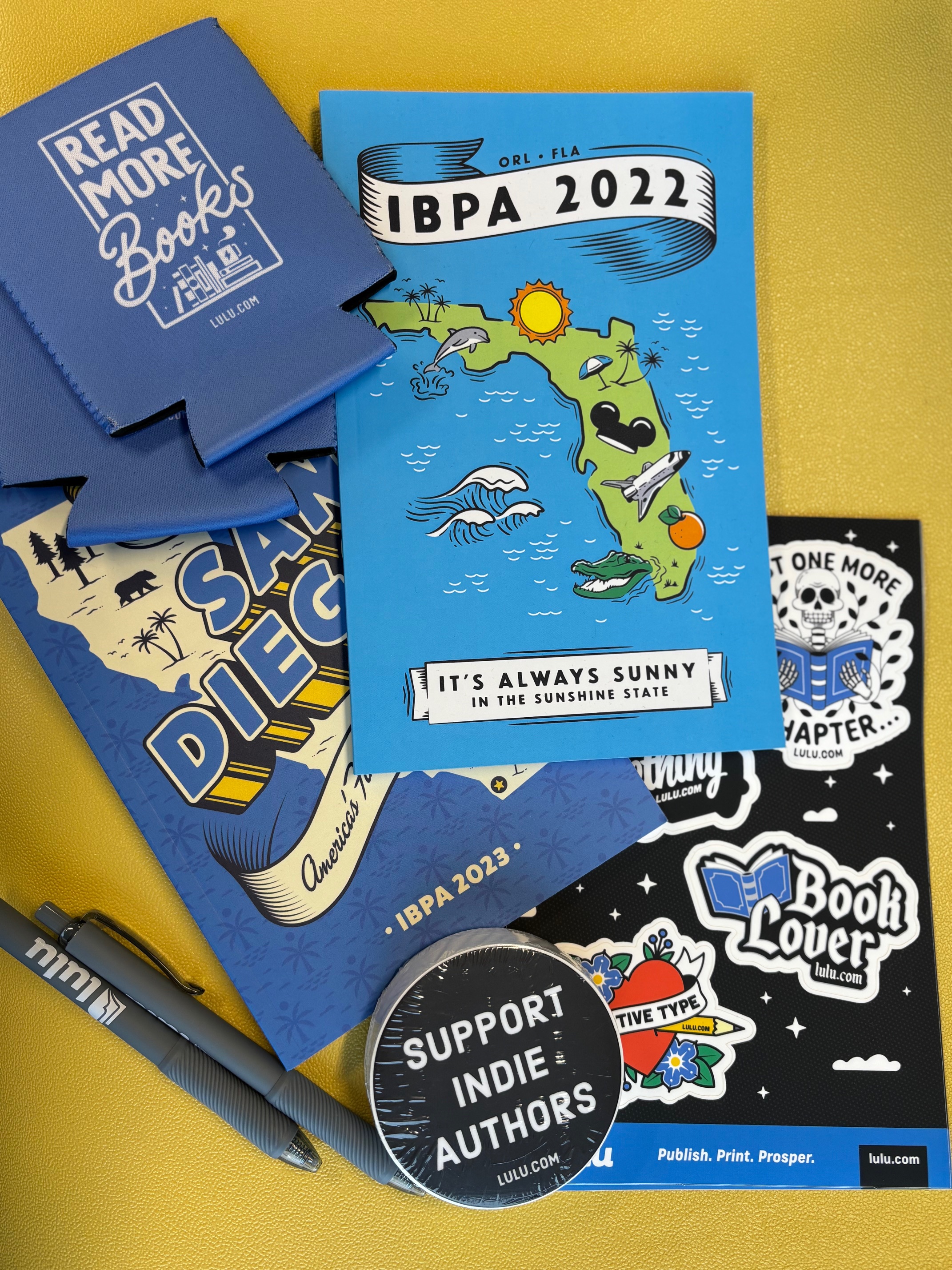 How do you define “swag” in the context of book and author marketing today? What forms are you seeing most often?
At Lulu, swag is anything that represents our brand that we give to attendees at an in-person event. It needs to be memorable, useful, and meaningful. Most often, we offer authors small items that align with the vibe of the event—something easy to pack and not likely to get left at the hotel or thrown away is key. We put a lot of thought into our swag, as several key decision-makers at Lulu are presented with ideas from our team. It needs to align with our brand.
From your experience, what are some of the most effective types of swag you’ve seen in terms of generating engagement, sales, or brand awareness?
For brand awareness, we like to give away items that the author would find useful. A koozie, a reusable bag, pens, or a printed journal. For engagement, anything that might draw a potential author to our booth is the goal.
How do you or your authors evaluate whether swag is actually paying off? What metrics or signs of success do you look for?
We don’t necessarily look at swag as something that needs to pay off immediately. Swag should be a vehicle for starting conversations. That said, from time to time, we experiment with new swag options, and if there is a ton left over at the end of an event, maybe the idea didn’t pay off as well as anticipated. Or if it’s flying off the table and we’re educating around what Lulu does, that’s a sign of success.
How can indie publishers and authors determine how much to spend on swag—and make sure that investment aligns with their goals?
We take pride in having great swag. We often hear “You guys always have the best swag!” at conferences. Our spending decision is a combination of anticipated foot traffic headcount plus the overall budget for the event.
How can publishers decide what kinds of swag resonate best with their target readers versus what might just be a vanity expense?
A few ways:
- Ask them! If a publisher is new to sponsoring and showcasing at events, a great way to decide on swag is to ask a few trusted clients for some ideas or favorites they’ve picked up in the past.
- Look around and see what authors are carrying with them. One of our most popular swag items was a reusable grocery bag that folded up into something smaller than my hand. This was at an event where the attendees needed something to carry their other swag. We also had koozies and an in-person event at the beach; they were a hit. Most recently, at the Frankfurt Book Fair, we gave away new business card holders. They were a hit and flew off the tables in just two days.
- Go to an event yourself and walk through the vendor booths. Make notes about what other publishers and vendors are giving away and the activity at their booth to get a sense of whether that swag is effective or not.
Are you seeing more value in sending swag to influencers and reviewers, or in-person events like conferences and book fairs?
We see most of the value at in-person events. We also send “thank you” swag to top-tier partners, close industry friends, and Lulu evangelists.
Sustainability and practicality are growing concerns in marketing. Have you seen any creative approaches to eco-friendly, reusable, or digital swag that still make an impact?
Yes! And this is a priority for the team at Lulu. We’re B Corp certified, so naturally, we have a strong connection to sustainability and transparency for sourcing. We’d prefer to buy local if possible, or to source swag products from reputable, sustainable stockists, even if this means we spend a little more or buy a smaller quantity. We don’t want to just throw down a bunch of plastic branded merch that traveled halfway around the world just to get thrown away.
One unique approach we’ve not yet tested but saw recently was a digital QR code that allowed the user to select where the publisher would make a donation by selecting from a small list of philanthropic groups. This was clever, as it eliminated having to ship swag, yet the customer was agreeing to give the brand their follow-up contact information. It resonated with the authors, as it was essentially free money for them to donate to a worthy cause. It seemed like a win-win for everyone.
Could you share a recent success story or campaign where swag clearly contributed to stronger results?
One example I saw recently involved a top-tier swag item—an expensive reusable water bottle. The catch was that if the author wanted it, they had to post on social media and tag the brand. This extended the reach of the swag to digital and social media, for which I’m not certain of the results, but it was interesting to see the use of swag in a multichannel approach.
Sarah Franklin is the public relations manager at Lulu Press.