What’s really happening with AI and writers, and what should publishers do about it?
The current discussion about AI is characterized by lots of shouting but very little factual information. My financial sponsor, Gotham Ghostwriters, and I set out to remedy that problem with a study called “AI and the Writing Profession” (gothamghostwriters.com/ai-writer). We surveyed 1,481 writers—1,190 nonfiction writing professionals and 291 fiction authors—on their use of and attitudes about AI.
What we found was surprising. Among the nonfiction writing professionals, 61% use AI tools. Most feel it has improved their productivity. But there is also a vociferous group of AI objectors, including the speechwriter who described AI as a “sociopathic plagiarism machine that’s prone to flattery, racism, and delusions, weakens critical thinking, and is an environmental disaster.”
We also found that both AI’s most enthusiastic users and most ardent detractors share a long list of concerns about the ethics of AI and its impact on the business of writing. Addressing these behaviors, attitudes, and differing sets of opinions may be publishing’s biggest challenge moving forward.
Who Uses AI Tools?
Except where otherwise noted, the analysis in this article is limited to nonfiction writing professionals such as and nonfiction authors, ghostwriters, journalists, and thought leadership writers.
In this group, 26% used AI tools daily, and 61% used them at least sometimes. The heaviest users were thought leadership writers (84% used AI; 33% daily) and content marketing writers (73% used AI; 36% daily). While 58% of nonfiction authors used AI, only 42% of fiction authors did. Of particular relevance in publishing: 61% of content editors and 33% of copy editors used AI.
You might imagine that younger writers would use AI more, but our data revealed very few differences in AI use by age or gender. But use varies by writers’ income. The average annual income of advanced AI users was $120,100, 64% higher than the $73,400 average income of AI non-users. It’s like that more highly paid professionals were attracted to AI’s promise to increase their productivity.
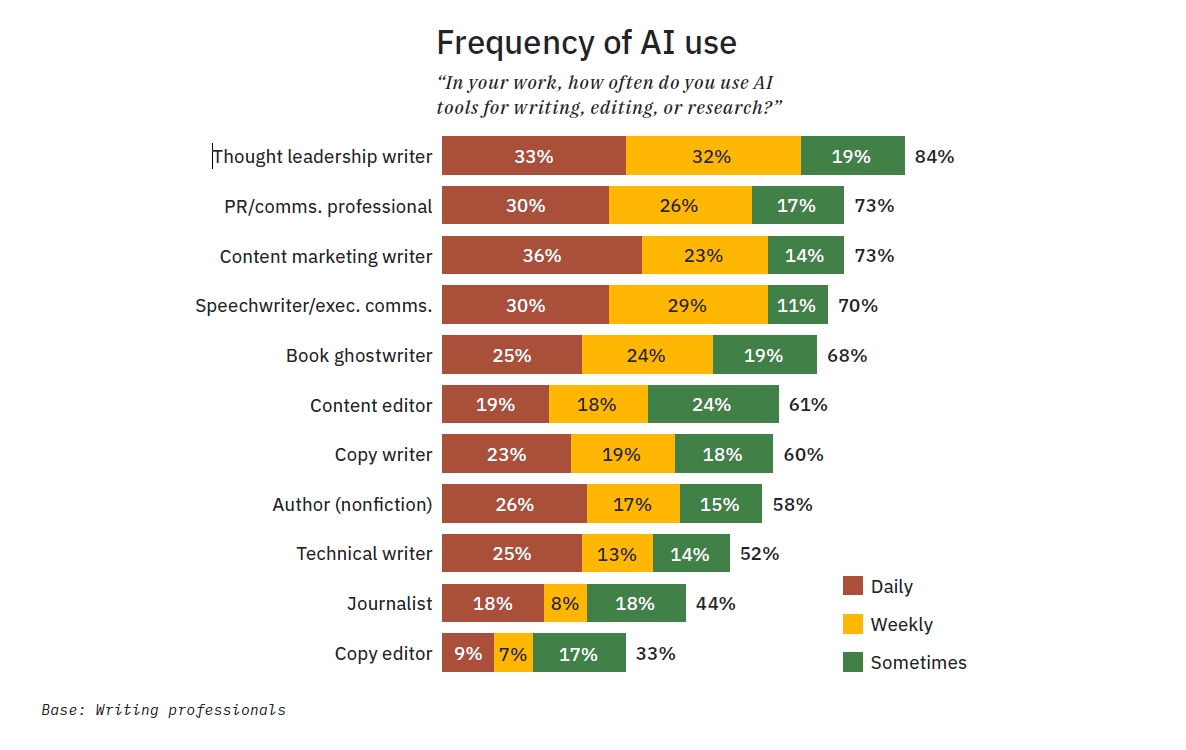 Despite the widespread alarm about AI-generated writing, writers don’t generally use it to create publishable text. The most popular uses among nonfiction writing professionals were suggesting titles and headings (72% of writers who used AI), as a replacement for web search (71%), as a brainstorming partner (68%), and as a thesaurus (68%). While 63% of writing professionals used AI to generate drafts of text that they then edited further, only 7% of writing professionals admitted to using AI to generate publishable content (and only 1% did that daily).
Nonfiction authors were most likely to embrace AI for search, other research, or as a thesaurus replacement. Ghostwriters liked it for search as well. Fiction authors who used AI were most likely to use it as a brainstorming partner.
The most popular AI applications were ChatGPT (76% of writers who used AI), Grammarly (37%), Claude (33%), Google Gemini (25%), and the AI search tool Perplexity (19%). Only 2% of writing professionals used the AI tool Grok, from the social network X.
AI Boosted Productivity
Many writers shared their enthusiasm for AI applications with us. “I waste less time endlessly googling trying to find real information instead of SEO trash,” said one content marketer. A ghostwriter volunteered, “I … use it to help me better match my client’s natural voice and tone … I’m amazed at how many times it’s helped me come out like a superhero with exactly what my client envisioned.” A thought leadership writer explained that they use it as an “emotional support robot [to] encourage me to keep going.” A fiction author was excited because AI could help them “explore all these worlds I have in my head and share them before I die.”
Among nonfiction writing professionals who use AI, 74% felt it made them more productive, reporting an average productivity increase of 31%. (Only 2% said it made them less productive.) The trend is even more pronounced among the most advanced AI users, 92% of whom reported productivity increases. Many AI users also think it helps them generate better prose; 43% of them said it allowed them to improve writing quality.
Users and Non-Users Shared AI Concerns
You might imagine that writers who didn’t use AI would be highly concerned. But we found that many users shared those same concerns.
For example, 97% of writers who don’t use AI worried that it generates false and erroneous information, sometimes described as “hallucinations.” But 80% of AI’s most advanced users were just as concerned about hallucinations.
Similarly, 94% of non-users and 61% of advanced users worried about AI that was trained on copyrighted materials used without permission. And 87% of non-users and 63% of advanced users were worried that AI was contributing to the trend of bland and boring content. The environmental impact of AI was on people’s minds as well. The drain on energy and water resources concerned 85% of non-users and 52% of advanced users.
Users and non-users were more divided on how to deal with AI. For example, 91% of AI non-users thought writing created with the aid of AI should be labelled, but only 25% of advanced AI users agreed. And only 3% of non-users felt AI was a positive force for the writing profession, even as 57% of AI’s most ardent users saw it as a positive.
A Profound Impact on the Writing Profession
Shockingly, about one in four writing professionals have considered giving up their writing career based on AI-driven change, a result that is consistent among AI users and non-users alike.
The impact on the business of writing is preoccupying all sorts of writers. A copy editor worried that it “removes the human authorial voice and repurposes it into corporate-friendly garbage, even in settings where that voice is not appropriate.” One ghostwriter was frustrated that “potential clients think it is a replacement for human writers.” And a speechwriter was demoralized that AI was demonstrating that “clients and readers often do not care about how accurate or good the writing is, just that it’s done.”
AI is already threatening the freelancing writing world. Of the freelance writing professionals in our survey, 45% said that AI had reduced demand for their work, and 40% had seen declines in income. And 43% of writing professionals knew a colleague who’d lost their job due to AI. Three out of four writers expected a decreased opportunity for professional writers due to AI. Some writers expected “Total decimation [of the profession],” that the “perceived value of quality writing will go way down,” and that AI “will largely eliminate the need for editors, artists, and many writers.”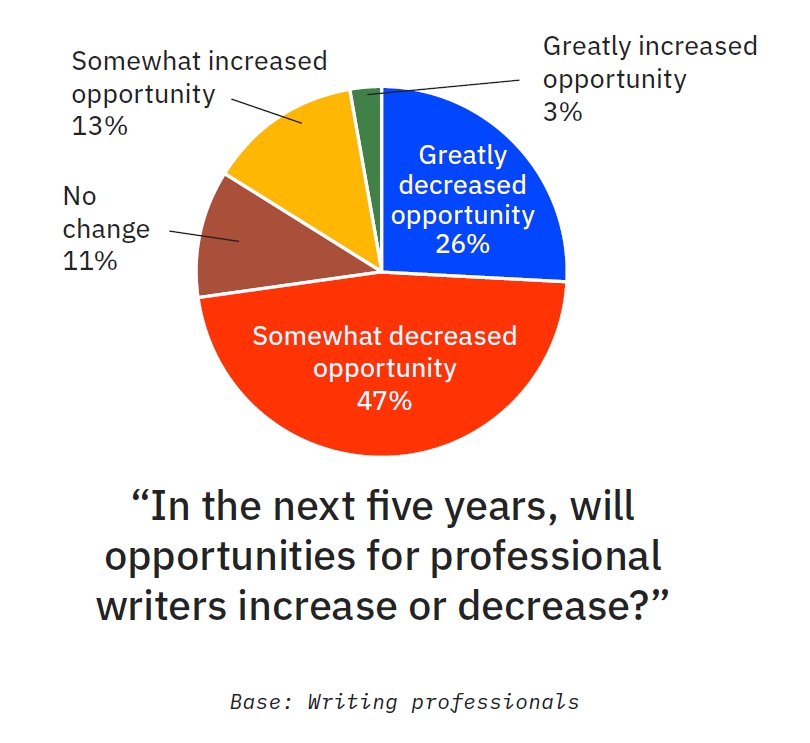
Or as one speechwriter hyperbolically put it, “Is ‘doom loop of computers writing regurgitated soulless garbage only to be read/summarized by other computers while humanity gets dumber and dumber and loses its ability to read, write, think and care’ overly pessimistic?”
Some Recommendations for the Publishing Industry
If you’re a publisher, these divisions in attitudes are likely reflected among the professionals in your company. Many of your authors and editors are using AI, while others almost certainly feel it is a pernicious evil.
As a former media analyst, I’ve watched technology-generated storms roil the book business before, from the rise of the web and social media to the increasing shift to e-books and audiobooks. People tend to catastrophize about new technologies. But optimism is not a strategy; profound AI-generated change is definitely on its way.
It’s clear that publishers must continue to pursue legal action to get fair compensation for the use of their content for AI training. But that’s not sufficient. No publisher can afford to eschew AI completely, nor can they become enthusiastic proponents.
The path to the future requires a more strategic perspective. Publishers should focus on three strategies. First, there are real productivity gains possible here, but identifying them isn’t simple. Find the most sophisticated AI users among your editorial ranks, and tap their expertise to train others in the ways that AI can make them more productive without losing their souls. Second, contribute to industrywide standards on AI use and disclosure, so authors, publishers, and readers can share a clearer understanding of just how AI is being used. And finally, seek out new technology-enabled ways to leverage AI for authors’ and publishers’ benefits, like creating book-based bots that readers can engage with.
As our data reveals, there’s widespread agreement that this technology is coming, that it threatens writers, and that it will profoundly change the book business. Hiding and resisting is not a strategy. Embracing the technology and turning it to your advantage is where the benefits lie.
Josh Bernoff is an expert on business books and how they can propel thinkers to prominence. His mathematical and statistical background includes three years of study in the Ph.D. program in mathematics at MIT. He has fielded surveys and written reports on the ROI of business books and the impact of AI on the writing profession. Bernoff writes and posts daily at Bernoff.com.